



Neurotensin Receptor
The neuropeptide neurotensin (NT) exerts central actionsthat include hypothermia, analgesia, and a number of effects that involve the modulation of nigrostriatal and mesocortico-limbic dopaminergic pathways. The two neurotensin receptor subtypes known to date, NTR1 and NTR2, belong to the family of G-protein-coupled receptors with seven putative transmembrane domains (TM). The NTR1 has high affinity for neurotensin, whereas the NTR2 has lower affinity for the peptide and is selectively recognized by levocabastine, an anti-histamine H1 receptor antagonist. These receptors have widespread, though not identical, central and peripheral distributions and exhibit distinct ontogenic profiles.
It is notably reported that NTR1 activation results in significant antinociception but also causes marked hypotension and hypothermia. In sharp contrast, NTR2 has emerged as an important pain target because NTR2-selective analogues exhibit potent analgesic activity in both acute and chronic pain conditions in dose-dependent analgesic effects without inducing drop in blood pressure or body temperature.
Neurotensin Receptor Isoform Specific Products
All Product Categories
-
Neurotensin Receptor Inhibitors
(22)
View all products
-
Neurotensin Receptor Agonists
(18)
View all products
-
Neurotensin Receptor Antagonists
(13)
View all products
-
Neurotensin Receptor Activators
(2)
View all products
-
Neurotensin Receptor Modulators
(6)
View all products
-
Neurotensin Receptor Inducer
(1)
View all products
-
Neurotensin Receptor Ligand
(1)
View all products
-
Neurotensin Receptor Related Products (75)
Related Products (75)

-
Antibodies (1)
-
Neurotensin Receptor Isoform Comparison
-
NTSR2 Human Pre-designed siRNA Set A
 0 ImagesCat. No.: HY-RS09641
NTSR2 Human Pre-designed siRNA Set A contains three designed siRNAs for NTSR2 gene (Human), as well as a negative control, a positive control, and a FAM-labeled negative control.
-
SORT1-IN-4
 0 ImagesCat. No.: HY-159877CAS No.: 2915675-58-8SORT1-IN-4 (compound 6) is a blood-brain barrier permeable SORT1 inhibitor.
-
[Trp11]-Neurotensin
![[Trp11]-Neurotensin](https://file.medchemexpress.com/product_pic/hy-p3057a.gif "Click to View [Trp11]-Neurotensin Product Detail") 0 ImagesCat. No.: HY-P3057ACAS No.: 75644-95-0[Trp11]-Neurotensin is a neurotensin analog and neurotensin receptor agonist. The Tyr11 residue of neurotensin is replaced by L-Trp. [Trp11]-Neurotensin competes for neurotensin receptor binding sites, with an IC50 of 4.3 nM in rat brain synaptic membranes, and activates neurotensin receptor-mediated smooth muscle responses, with an EC50 of 1.7 nM in rat ileum, exhibiting significant species-dependent differences in receptor recognition. [Trp11]-Neurotensin can be used in studies related to neurotensin receptor pharmacology, gastrointestinal smooth muscle, and species-dependent receptor recognition.
0 ImagesCat. No.: HY-P3057ACAS No.: 75644-95-0[Trp11]-Neurotensin is a neurotensin analog and neurotensin receptor agonist. The Tyr11 residue of neurotensin is replaced by L-Trp. [Trp11]-Neurotensin competes for neurotensin receptor binding sites, with an IC50 of 4.3 nM in rat brain synaptic membranes, and activates neurotensin receptor-mediated smooth muscle responses, with an EC50 of 1.7 nM in rat ileum, exhibiting significant species-dependent differences in receptor recognition. [Trp11]-Neurotensin can be used in studies related to neurotensin receptor pharmacology, gastrointestinal smooth muscle, and species-dependent receptor recognition.

-
JMV 449
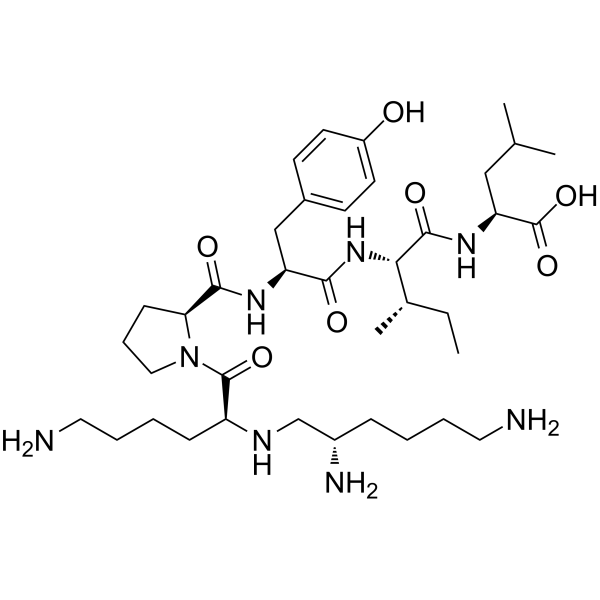 0 ImagesCat. No.: HY-P1256CAS No.: 139026-66-7JMV 449 is a potent neurotensin receptor agonist. JMV 449 shows an IC50 of 0.15 nM for inhibition of [125I]-neurotensin binding to neonatal mouse brain and an EC50 of 1.9 nM in contracting the guinea-pig ileum. JMV 449 has highly potent and long-lasting hypothermic and analgesic effects in the mouse.
-
JMV 7490
 0 ImagesCat. No.: HY-P11594JMV 7490 is a highly potent and highly hydrophilic neurotensin receptor NTS1 probe that can be successfully labeled with 68Ga and 111In. JMV 7490 acts as an efflux inhibitor to reduce its efflux in NTS1-positive cancer cells; it also serves as an internalization inducer and is efficiently and continuously internalized by NTS1-positive cancer cells. 111In-radiolabeled JMV 7490 shows persistent uptake in NTS1-positive xenografts in nude mice, but no significant uptake in NTS1-negative xenografts. JMV 7490 can be used for in vivo tracer applications of NTS1-positive tumors and supports related research on colorectal cancer.
-
POPG-d62
 0 ImagesCat. No.: HY-178787SSynonyms: PG(16:0/18:1)-d62; 1-Palmitoyl-2-oleoyl-sn-glycero-3-phospho-(1'-rac-glycerol)-d62POPG-d62 (PG(16:0/18:1)-d62) is the deuterium labeled POPG (HY-142991). POPG sodium salt is a negatively charged phospholipid. POPG sodium salt affects the interactions of membrane proteins with other molecules by changing the charge characteristics of the lipid environment. POPG sodium salt increases the apparent affinity of Gαq and Gβ1γ1 for activated NTS1. POPG sodium salt can interact with the positive charge of peptides. POPG sodium salt can be used in Parkinson's disease research.
-
(D-Tyr11)-Neurotensin
 0 ImagesCat. No.: HY-P0234ACAS No.: 64088-62-6(D-Tyr11)-Neurotensin is an agonist of neurotensin receptor (Neurotensin Receptor) and an inhibitor of glutamatergic neurotransmission. Activation of NTR1 in the VTA by (D-Tyr11)-Neurotensin enhances glutamatergic inputs to non-dopaminergic neurons, mediating reward and dopamine efflux; meanwhile, activation of NTR2 reduces glutamatergic excitatory postsynaptic currents (EPSC) in dopaminergic neurons. (D-Tyr11)-Neurotensin can be used in studies related to schizophrenia.
-
SORT1-IN-2
 0 ImagesCat. No.: HY-159875CAS No.: 2854233-44-4SORT1-IN-2 (compound 6) is a SORT1 inhibitor.
-
BIM-46174
 0 ImagesCat. No.: HY-183400CAS No.: 195450-11-4BIM-46174 is a heterotrimeric G protein complex inhibitor. BIM-46174 blocks GPCR downstream signaling by trapping Gα proteins in a nucleotide-free pocket conformation, thereby inhibiting Gαq-mediated calcium release, Gαs-mediated cAMP production, and GPCR-regulated cancer cell invasion. In vitro, BIM-46174 effectively suppresses a variety of clinically multidrug-resistant cell lines and induces tumor cell apoptosis through activation of caspase-3 and PARP cleavage. BIM-46174 also inhibits activation of the Neu1-MMP-9-GPCR signaling platform and downstream NF-κB signaling, and is widely used in the study of cancer signaling pathways and inflammation-related research, including lung cancer, pancreatic cancer, breast cancer, melanoma, and leukemia.
-
Levocabastine hydrochloride (Standard)
 0 ImagesCat. No.: HY-14277ARCAS No.: 79547-78-7Synonyms: R 50547 hydrochloride (Standard)Levocabastine (hydrochloride) (Standard) is the analytical standard of Levocabastine (hydrochloride). This product is intended for research and analytical applications. Levocabastine (R 50547) hydrochloride is a potent and selective histamine H1-receptor antagonist. Levocabastine hydrochloride is also a selective, high affinity neurotensin receptor subtype 2 (NTR2) antagonist, with a Ki of 17 nM for mNTR2. Levocabastine hydrochloride can act as a VLA-4 antagonist, interferes with conjunctival eosinophil infiltration in allergic conjunctivitis (AC).
-
SR 142948 (Standard)
 0 ImagesCat. No.: HY-107664RCAS No.: 184162-64-9SR 142948 (Standard) is the analytical standard of SR 142948 (HY-107664). This product is intended for research and analytical applications. SR 142948 is an orally active and selective non-peptide neurotensin receptor (NT) antagonist with IC50s of 1.19 nM, 0.32 nM, 3.96 nM in h-NTR1-CHO cells, HT-29 cells, and adult rat brain, respectively. SR 142948 antagonizes NT-induced inositol monophosphate formation in HT-29 cells with an IC50 of 3.9 nM. SR 142948 blocks hypothermia, analgesia and steering behavior induced by NT in vivo. SR 142948 shows blood-brain permeability and can be used in study of psychiatric disorders.
-
L-156903
 0 ImagesCat. No.: HY-129793CAS No.: 116740-51-3L-156903 potently inhibits neurotensin (NT) binding to brain tissue.
-
LM11A-31 dihydrochloride (Standard)
 0 ImagesCat. No.: HY-110155RCAS No.: 1243259-19-9LM11A-31 dihydrochloride (Standard) is the analytical standard of LM11A-31 (dihydrochloride) (HY-110155). This product is intended for research and analytical applications. LM11A-31 dihydrochloride, a non-peptide p75NTR (neurotrophin receptor p75) modulator, is an orally active and potent proNGF (nerve growth factor) antagonist. LM11A-31 dihydrochloride is an amino acid derivative with high blood-brain barrier permeability and blocks p75-mediated cell death. LM11A-31 dihydrochloride reverses cholinergic neurite dystrophy in Alzheimer's disease mouse models with mid- to late-stage disease progression.
-
POPG sodium (Standard)
 0 ImagesCat. No.: HY-130463RCAS No.: 268550-95-4Synonyms: PG(16:0/18:1) sodium (Standard); 1-Palmitoyl-2-oleoyl-sn-glycero-3-phospho-(1'-rac-glycerol) sodium (Standard)POPG (Standard) (PG(16:0/18:1) (Standard)) sodium is the analytical standard of POPG (sodium) (HY-130463). This product is intended for research and analytical applications. POPG (sodium) is a negatively charged phospholipid. POPG (sodium) affects the interactions of membrane proteins with other molecules by changing the charge characteristics of the lipid environment. POPG (sodium) increases the apparent affinity of Gαq and Gβ1γ1 for activated NTS1. POPG (sodium) can interact with the positive charge of peptides. POPG sodium salt can be used in Parkinson's disease research.




